Seismic Activity in Chile
Over the past 30 days, there have been 13 recorded earthquakes in this region. The largest recent earthquake was a magnitude 5.2 event near 62 km SW of San Antonio, Chile.
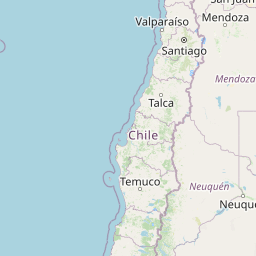
Over the past 30 days, Chile has recorded 13 earthquakes of magnitude 2.5 or greater in our tracker. 1 reached magnitude 5.0 or higher. 11 landed between M4.0 and M4.9. The remaining 1 fell in the M2.5–M3.9 band. By depth: 9 shallow (<70 km), 4 intermediate (70–300 km). 4 of the epicenters were offshore. 6 events produced at least one felt report, totalling 53 citizen submissions to the USGS Did You Feel It? system. Focal depths ranged from 10.0 km to 174.3 km. All 13 solutions have been reviewed by a USGS seismologist.
Each row in the table below includes a narrative summary of the event, ordered by time. Use the column headers to sort or filter by magnitude.
| Time ↓ | Mag ↕ | Location ↕ | Depth ↕ | Felt ↕ | MMI | Alert | Status | Details |
|---|---|---|---|---|---|---|---|---|
21 hours ago 2026-10-02 17:28:18 UTC | 4.3mwr | 30 km NNW of Valparaíso, Chile -32.773°, -71.707° | 32.1 km | 3 | - | - | ✓ Reviewed | USGS → |
This magnitude 4.3 event was detected 30 km NNW of Valparaíso, Chile on October 2, 2026, with origin time 17:28 UTC. See the M4.3 event page for the full report, ShakeMap, and citizen-reported intensity data. | ||||||||
6 days ago 2026-09-27 04:14:44 UTC | 4.5mb | 145 km WNW of Lebu, Chile -37.136°, -75.190° | 10.0 km | - | - | - | ✓ Reviewed | USGS → |
At 04:14 UTC on September 27, 2026, a magnitude 4.5 tremor occurred 145 km WNW of Lebu, Chile. See the M4.5 event page for the full report, ShakeMap, and citizen-reported intensity data. | ||||||||
2026-09-25 2026-09-25 15:29:09 UTC | 5.2mww | 62 km SW of San Antonio, Chile -33.966°, -72.108° | 29.1 km | 8 | - | - | ✓ Reviewed | USGS → |
On September 25, 2026 at 15:29 UTC, a magnitude 5.2 earthquake struck 62 km SW of San Antonio, Chile. It is the largest earthquake currently listed for Chile over the past 30 days. See the M5.2 event page for the full report, ShakeMap, and citizen-reported intensity data. | ||||||||
2026-09-24 2026-09-24 23:19:34 UTC | 4.2mb | 63 km WSW of Andacollo, Argentina -37.462°, -71.293° | 174.3 km | - | - | - | ✓ Reviewed | USGS → |
On September 24, 2026 at 23:19 UTC, a magnitude 4.2 earthquake struck 63 km WSW of Andacollo, Argentina. This is the deepest earthquake in the current dataset — an intermediate depth event. See the M4.2 event page for the full report, ShakeMap, and citizen-reported intensity data. | ||||||||
2026-09-24 2026-09-24 07:07:05 UTC | 4.3mb | 53 km WSW of San Antonio, Chile -33.829°, -72.106° | 31.4 km | - | - | - | ✓ Reviewed | USGS → |
Reports of a magnitude 4.3 earthquake 53 km WSW of San Antonio, Chile came in on September 24, 2026 at 07:07 UTC. See the M4.3 event page for the full report, ShakeMap, and citizen-reported intensity data. | ||||||||
2026-09-23 2026-09-23 03:07:08 UTC | 4.2mb | 33 km NNW of La Serena, Chile -29.619°, -71.376° | 62.4 km | 1 | - | - | ✓ Reviewed | USGS → |
A magnitude 4.2 earthquake was recorded 33 km NNW of La Serena, Chile on September 23, 2026 at 03:07 UTC. See the M4.2 event page for the full report, ShakeMap, and citizen-reported intensity data. | ||||||||
2026-09-19 2026-09-19 13:25:03 UTC | 4.4mb | 34 km NW of Coquimbo, Chile -29.723°, -71.575° | 39.0 km | - | - | - | ✓ Reviewed | USGS → |
The USGS recorded this magnitude 4.4 earthquake 34 km NW of Coquimbo, Chile at 13:25 UTC on September 19, 2026. The event was offshore. See the M4.4 event page for the full report, ShakeMap, and citizen-reported intensity data. | ||||||||
2026-09-18 2026-09-18 16:52:07 UTC | 4.8mwr | 28 km ENE of Villa Presidente Frei, Chile -33.322°, -70.317° | 100.1 km | 34 | - | - | ✓ Reviewed | USGS → |
A magnitude 4.8 earthquake was recorded 28 km ENE of Villa Presidente Frei, Chile on September 18, 2026 at 16:52 UTC. See the M4.8 event page for the full report, ShakeMap, and citizen-reported intensity data. | ||||||||
2026-09-17 2026-09-17 15:51:18 UTC | 4.6mb | 26 km WSW of Osorno, Chile -40.635°, -73.437° | 59.7 km | 1 | - | - | ✓ Reviewed | USGS → |
On September 17, 2026, Chile registered a magnitude 4.6 earthquake 26 km WSW of Osorno, Chile at 15:51 UTC. See the M4.6 event page for the full report, ShakeMap, and citizen-reported intensity data. | ||||||||
2026-09-13 2026-09-13 12:36:14 UTC | 3.9mwr | 90 km WNW of Cartagena, Chile -33.331°, -72.547° | 10.0 km | - | - | - | ✓ Reviewed | USGS → |
Seismographs logged a magnitude 3.9 earthquake 90 km WNW of Cartagena, Chile with origin time 12:36 UTC on September 13, 2026. See the M3.9 event page for the full report, ShakeMap, and citizen-reported intensity data. | ||||||||
2026-09-07 2026-09-07 22:25:36 UTC | 4.3mb | 13 km E of San Clemente, Chile -35.545°, -71.335° | 108.3 km | - | - | - | ✓ Reviewed | USGS → |
A magnitude 4.3 seismic event took place 13 km E of San Clemente, Chile on September 7, 2026 at 22:25 UTC. The event was offshore. See the M4.3 event page for the full report, ShakeMap, and citizen-reported intensity data. | ||||||||
2026-09-06 2026-09-06 06:09:07 UTC | 4.3mb | 10 km SW of Lautaro, Chile -38.600°, -72.525° | 64.6 km | - | - | - | ✓ Reviewed | USGS → |
September 6, 2026 brought a magnitude 4.3 earthquake 10 km SW of Lautaro, Chile, logged at 06:09 UTC. The event was offshore. See the M4.3 event page for the full report, ShakeMap, and citizen-reported intensity data. | ||||||||
2026-09-03 2026-09-03 21:18:21 UTC | 4.8mww | 28 km WSW of Salamanca, Chile -31.882°, -71.237° | 83.6 km | 6 | - | - | ✓ Reviewed | USGS → |
Seismographs logged a magnitude 4.8 earthquake 28 km WSW of Salamanca, Chile with origin time 21:18 UTC on September 3, 2026. See the M4.8 event page for the full report, ShakeMap, and citizen-reported intensity data. | ||||||||
62 km SW of San Antonio, Chile
2026-09-25
71 km W of Vallenar, Chile
2026-03-13
Data from USGS Earthquake Hazards Program. Updated every 5 minutes.
Chile lies along the Pacific Ring of Fire and has experienced some of history's largest earthquakes, including the 1960 Valdivia earthquake, the most powerful ever recorded.
In 2026, Chile has recorded 182 earthquakes of magnitude 2.5 or greater so far. The largest earthquake in Chile in 2026 was a magnitude 6.2 event near Vallenar, Chile.
Over the past 30 days, there have been 13 recorded earthquakes in this region. The largest recent earthquake was a magnitude 5.2 event near 62 km SW of San Antonio, Chile.
In the past 30 days, 13 earthquakes have been recorded in the Chile region.
The largest recent earthquake in the Chile area was a magnitude 5.2 event that occurred 62 km SW of San Antonio, Chile.
Argentina experiences earthquakes primarily in its western Andean regions where ...
Bolivia experiences deep earthquakes from the subducting Nazca Plate. The 1994 d...
Peru lies along the Pacific Ring of Fire where the Nazca Plate subducts beneath ...
Ecuador's location along the Nazca-South American plate boundary results in freq...