Earthquakes in Los Angeles, California
Last earthquake: 2 hours ago · 217 in past 30 days · Largest: M3.3 · Population 3.9M
Last updated: September 15, 2026 at 01:21 PM UTC · Data: USGS Earthquake Hazards Program
No significant earthquakes recorded near Los Angeles recently. Last M2.5+: 2 days ago.
Quick Facts — Earthquakes in Los Angeles
- Population
- 3.9M
- Seismic activity level
- very high
- Nearest major fault
- Newport-Inglewood Fault (8 km)
- Largest recorded nearby
- M7.5 (1952 Kern County earthquake)
- 30-year probability M6.7+
- 60% (UCERF3)
- Earthquakes past 30 days
- 217
- Last significant (M2.5+)
- 2 days ago
- 2026 total (M1.0+)
- 1093
Los Angeles experienced a magnitude 3.3 earthquake 3 days ago 26 km ESE of Avalon, CA, at a depth of 10.7 km. Over the past 7 days, 137 earthquakes (M1.0+) have been recorded within 100 km.
Los Angeles sits in the very high category for U.S. seismic activity. The largest earthquake in or near Los Angeles since records began was the magnitude 7.5 Kern County earthquake in 1952, which struck approximately 130 km north of the city.
According to the U.S. Geological Survey's UCERF3 model, there is approximately a 60% probability of a magnitude 6.7 or greater earthquake within 100 km of Los Angeles in the next 30 years, and a 46% probability of a magnitude 7.0 or greater event. The largest credible earthquake predicted for the Los Angeles area is a magnitude 7.4 event on the Newport-Inglewood Fault, which lies 8 km from downtown Los Angeles. Source: UCERF3 (Field et al. 2015), Table 7 — LA region
Los Angeles sits in a region characterized by the San Andreas transform fault system, where the Pacific and North American plates slide past each other at roughly 46 mm per year. Beyond the Newport-Inglewood Fault, secondary fault systems include the Puente Hills Thrust Fault and Hollywood Fault. View all earthquakes in California.
2026 Activity vs Historical Average
Recent Significant Earthquakes Near Los Angeles
Earthquake Map — Los Angeles Area
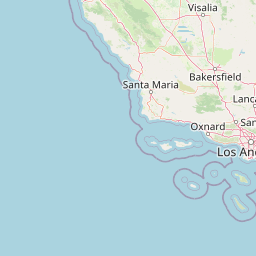
Fault Lines Near Los Angeles
| Fault Name | Type | Distance | Max Credible Mag | Last Major Rupture |
|---|---|---|---|---|
| Newport-Inglewood Fault | right-lateral strike-slip | 8 km | M7.4 | 1933 (M6.4 Long Beach) |
| Puente Hills Thrust Fault | thrust | 5 km | M7.5 | blind thrust — paleoseismic data limited |
| Hollywood Fault | reverse | 12 km | M6.8 | unknown |
| San Andreas Fault (Mojave segment) | right-lateral strike-slip | 60 km | M8.0 | 1857 (M7.9 Fort Tejon) |
| Sierra Madre Fault | reverse | 25 km | M7.5 | paleoseismic data limited |
Recent Earthquakes (Last 30 Days)
Dataset at a glance — Los Angeles
Over the past 30 days, Los Angeles has recorded 217 earthquakes of magnitude 2.5 or greater in our tracker. The remaining 11 fell in the M2.5–M3.9 band. By depth: 217 shallow (<70 km). 104 of the epicenters were offshore. 16 events produced at least one felt report, totalling 2,141 citizen submissions to the USGS Did You Feel It? system. Focal depths ranged from -0.9 km to 27.1 km. 136 of the 217 solutions have been reviewed by a USGS seismologist; the remaining 81 are automatic and may be refined.
Each row in the table below includes a narrative summary of the event, ordered by time. Use the column headers to sort or filter by magnitude.
| Time ↓ | Mag ↕ | Location ↕ | Depth ↕ | Felt ↕ | MMI | Alert | Status | Details |
|---|---|---|---|---|---|---|---|---|
2 days ago 2026-09-13 03:47:00 UTC | 2.6ml | 27 km SSE of Malibu, CA 33.774°, -118.736° | -0.1 km | 3 | - | - | ✓ Reviewed | USGS → |
September 13, 2026 brought a magnitude 2.6 earthquake 27 km SSE of Malibu, CA, logged at 03:47 UTC. This very shallow event was close enough to the surface that even modest magnitudes can produce significant local shaking. See the M2.6 event page for the full report, ShakeMap, and citizen-reported intensity data. | ||||||||
3 days ago 2026-09-12 11:32:19 UTC | 2.6ml | 4 km E of Lennox, CA 33.937°, -118.304° | 19.4 km | 23 | - | - | ✓ Reviewed | USGS → |
This magnitude 2.6 event was detected 4 km E of Lennox, CA on September 12, 2026, with origin time 11:32 UTC. In the 72 hours after this event, the USGS recorded 20 smaller earthquakes within 20 km, consistent with an ongoing aftershock sequence rooted here. See the M2.6 event page for the full report, ShakeMap, and citizen-reported intensity data. | ||||||||
3 days ago 2026-09-12 11:13:58 UTC | 3.3ml | 26 km ESE of Avalon, CA 33.259°, -118.065° | 10.7 km | 8 | - | - | ✓ Reviewed | USGS → |
On September 12, 2026 at 11:13 UTC, a magnitude 3.3 earthquake struck 26 km ESE of Avalon, CA. In the 72 hours after this event, the USGS recorded 3 smaller earthquakes within 20 km, consistent with an ongoing aftershock sequence rooted here. See the M3.3 event page for the full report, ShakeMap, and citizen-reported intensity data. | ||||||||
3 days ago 2026-09-12 11:11:59 UTC | 3.0ml | 26 km ESE of Avalon, CA 33.254°, -118.067° | 10.8 km | - | - | - | ✓ Reviewed | USGS → |
On September 12, 2026, Los Angeles registered a magnitude 3.0 earthquake 26 km ESE of Avalon, CA at 11:11 UTC. In the 72 hours after this event, the USGS recorded 3 smaller earthquakes within 20 km, consistent with an ongoing aftershock sequence rooted here. See the M3.0 event page for the full report, ShakeMap, and citizen-reported intensity data. | ||||||||
3 days ago 2026-09-12 11:03:25 UTC | 2.5ml | 26 km ESE of Avalon, CA 33.244°, -118.074° | 12.3 km | - | - | - | ✓ Reviewed | USGS → |
On September 12, 2026 at 11:03 UTC, a magnitude 2.5 earthquake struck 26 km ESE of Avalon, CA. In the 72 hours after this event, the USGS recorded 3 smaller earthquakes within 20 km, consistent with an ongoing aftershock sequence rooted here. See the M2.5 event page for the full report, ShakeMap, and citizen-reported intensity data. | ||||||||
3 days ago 2026-09-12 07:34:56 UTC | 2.6ml | 5 km WNW of Willowbrook, CA 33.930°, -118.302° | 19.1 km | 24 | - | - | ✓ Reviewed | USGS → |
Reports of a magnitude 2.6 earthquake 5 km WNW of Willowbrook, CA came in on September 12, 2026 at 07:34 UTC. In the 72 hours after this event, the USGS recorded 71 smaller earthquakes within 20 km, consistent with an ongoing aftershock sequence rooted here. See the M2.6 event page for the full report, ShakeMap, and citizen-reported intensity data. | ||||||||
4 days ago 2026-09-11 10:19:23 UTC | 2.6ml | 6 km W of Edwards Air Force Base, CA 34.909°, -117.992° | 8.3 km | 7 | - | - | ✓ Reviewed | USGS → |
A magnitude 2.6 seismic event took place 6 km W of Edwards Air Force Base, CA on September 11, 2026 at 10:19 UTC. The event was offshore. See the M2.6 event page for the full report, ShakeMap, and citizen-reported intensity data. | ||||||||
2026-09-06 2026-09-06 07:13:11 UTC | 3.1ml | 4 km SSE of Compton, CA 33.864°, -118.210° | 15.8 km | 1,124 | III | - | ✓ Reviewed | USGS → |
Seismographs logged a magnitude 3.1 earthquake 4 km SSE of Compton, CA with origin time 07:13 UTC on September 6, 2026. In the 72 hours after this event, the USGS recorded 3 smaller earthquakes within 20 km, consistent with an ongoing aftershock sequence rooted here. See the M3.1 event page for the full report, ShakeMap, and citizen-reported intensity data. | ||||||||
2026-09-02 2026-09-02 12:37:12 UTC | 3.2ml | 6 km SE of Ontario, CA 34.014°, -117.589° | 6.1 km | 730 | III | - | ✓ Reviewed | USGS → |
A magnitude 3.2 earthquake was recorded 6 km SE of Ontario, CA on September 2, 2026 at 12:37 UTC. The event was offshore. See the M3.2 event page for the full report, ShakeMap, and citizen-reported intensity data. | ||||||||
2026-08-18 2026-08-18 13:12:45 UTC | 2.7ml | 35 km NNW of Santa Barbara Is., CA 33.762°, -119.214° | 0.7 km | 3 | - | - | ✓ Reviewed | USGS → |
The USGS recorded this magnitude 2.7 earthquake 35 km NNW of Santa Barbara Is., CA at 13:12 UTC on August 18, 2026. This very shallow event was close enough to the surface that even modest magnitudes can produce significant local shaking. See the M2.7 event page for the full report, ShakeMap, and citizen-reported intensity data. | ||||||||
2026-08-16 2026-08-16 20:35:29 UTC | 2.8ml | 6 km SE of Ontario, CA 34.011°, -117.589° | 5.6 km | 128 | - | - | ✓ Reviewed | USGS → |
At 20:35 UTC on August 16, 2026, a magnitude 2.8 tremor occurred 6 km SE of Ontario, CA. The event was offshore. See the M2.8 event page for the full report, ShakeMap, and citizen-reported intensity data. | ||||||||
Common Questions About Earthquakes in Los Angeles
How often do earthquakes happen in Los Angeles?
Los Angeles experiences frequent earthquake activity. The area averages 165 earthquakes of magnitude 3.0 or greater per year, with 1.5 reaching magnitude 5.0 or higher. In the past 30 days, 217 earthquakes (M1.0+) have been recorded within 100 km of the city.
What was the biggest earthquake to hit Los Angeles?
The largest earthquake in or near Los Angeles since records began was the magnitude 7.5 Kern County earthquake in 1952, which struck approximately 130 km north of the city.
What is the earthquake risk in Los Angeles?
Earthquakes cannot be predicted with precision. However, the U.S. Geological Survey estimates there is approximately a 60% probability of a magnitude 6.7 or greater earthquake within 100 km of Los Angeles in the next 30 years. The most likely source is the Newport-Inglewood Fault, which has a maximum credible magnitude of 7.4.
What fault lines are near Los Angeles?
The Newport-Inglewood Fault runs approximately 8 km from Los Angeles and is the most significant local seismic threat, with a maximum credible magnitude of 7.4. Other nearby faults include the Puente Hills Thrust Fault (5 km), the Hollywood Fault (12 km), the San Andreas Fault (Mojave segment) (60 km).
Was there an earthquake in Los Angeles today?
No earthquakes of magnitude 2.5 or greater have been recorded near Los Angeles in the past 24 hours. The most recent M2.5+ event was 2 days ago.
About This Page
This page is maintained by Earthquake Tracker, an independent seismic activity reporting service. Earthquake data is sourced from the U.S. Geological Survey (USGS) Earthquake Hazards Program and updated every hour. Probability estimates use the USGS Uniform California Earthquake Rupture Forecast (UCERF3) for California cities. Historical earthquake data is sourced from the USGS Historical Earthquake Catalog. Fault information comes from the USGS Quaternary Fault and Fold Database and SCEC Community Fault Model.
Last data refresh: September 15, 2026 at 01:21 PM UTC