Earthquakes in Las Vegas, Nevada
Last earthquake: 18 days ago · 2 in past 30 days · Largest: M2.4 · Population 642K
Last updated: September 15, 2026 at 02:22 PM UTC · Data: USGS Earthquake Hazards Program
No significant earthquakes recorded near Las Vegas recently. No M2.5+ events within 75 km in the past 30 days.
Quick Facts — Earthquakes in Las Vegas
- Population
- 642K
- Seismic activity level
- moderate
- Nearest major fault
- Frenchman Mountain Fault (15 km)
- Largest recorded nearby
- M5.7 (1992 Little Skull Mountain earthquake)
- 30-year probability M6.7+
- 12% (NSHM)
- Earthquakes past 30 days
- 2
- 2026 total (M1.0+)
- 62
The Las Vegas area averages about 0.5 magnitude 4.0+ earthquakes per year and has recorded 2 earthquakes (M1.0+) within 75 km in the past 30 days. The largest event in the past 30 days was a magnitude 2.4 event 10 km SSE of Enterprise, Nevada.
Las Vegas sits in the moderate category for U.S. seismic activity. The largest earthquake in or near Las Vegas since records began was the magnitude 5.7 Little Skull Mountain earthquake in 1992, which struck approximately 90 km northwest of the city.
According to the U.S. Geological Survey's National Seismic Hazard Model, there is approximately a 12% probability of a magnitude 6.7 or greater earthquake within 100 km of Las Vegas in the next 30 years, and a 5% probability of a magnitude 7.0 or greater event. The largest credible earthquake predicted for the Las Vegas area is a magnitude 6.8 event on the Frenchman Mountain Fault, which lies 15 km from downtown Las Vegas. Source: Nevada Seismological Laboratory; USGS NSHM 2023
Las Vegas sits in a region characterized by Basin and Range extensional tectonics, where normal faulting accommodates east-west crustal stretching at approximately 10 mm per year. Beyond the Frenchman Mountain Fault, secondary fault systems include the Las Vegas Valley Fault System and Death Valley Fault Zone. View all earthquakes in Nevada.
2026 Activity vs Historical Average
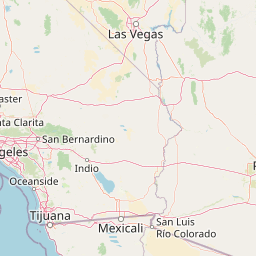
Earthquake Map — Las Vegas Area
Fault Lines Near Las Vegas
| Fault Name | Type | Distance | Max Credible Mag | Last Major Rupture |
|---|---|---|---|---|
| Frenchman Mountain Fault | normal | 15 km | M6.8 | paleoseismic data limited |
| Las Vegas Valley Fault System | normal | 5 km | M6.5 | unknown |
| Death Valley Fault Zone | right-lateral strike-slip | 130 km | M7.5 | paleoseismic data limited |
| Pahrump Valley Fault | right-lateral strike-slip | 80 km | M7.0 | paleoseismic data limited |
Recent Earthquakes (Last 30 Days)
Dataset at a glance — Las Vegas
Over the past 30 days, Las Vegas has recorded 2 earthquakes of magnitude 2.5 or greater in our tracker. By depth: 2 shallow (<70 km). 1 of the epicenters were offshore. Focal depths ranged from 6.0 km to 16.0 km. 1 of the 2 solutions have been reviewed by a USGS seismologist; the remaining 1 are automatic and may be refined.
Each row in the table below includes a narrative summary of the event, ordered by time. Use the column headers to sort or filter by magnitude.
| Time ↓ | Mag ↕ | Location ↕ | Depth ↕ | Felt ↕ | MMI | Alert | Status | Details |
|---|---|---|---|---|---|---|---|---|
2026-08-27 2026-08-27 20:11:46 UTC | 2.4ml | 10 km SSE of Enterprise, Nevada 35.938°, -115.187° | 6.0 km | - | - | - | Auto | USGS → |
On August 27, 2026 at 20:11 UTC, a magnitude 2.4 earthquake struck 10 km SSE of Enterprise, Nevada. It is the largest earthquake currently listed for Las Vegas over the past 30 days. See the M2.4 event page for the full report, ShakeMap, and citizen-reported intensity data. | ||||||||
2026-08-18 2026-08-18 18:12:49 UTC | 1.5ml | 4 km N of Blue Diamond, Nevada 36.090°, -115.394° | 16.0 km | - | - | - | ✓ Reviewed | USGS → |
A magnitude 1.5 earthquake was recorded 4 km N of Blue Diamond, Nevada on August 18, 2026 at 18:12 UTC. The event was offshore. See the M1.5 event page for the full report, ShakeMap, and citizen-reported intensity data. | ||||||||
Common Questions About Earthquakes in Las Vegas
How often do earthquakes happen in Las Vegas?
Las Vegas experiences moderate earthquake activity. The area averages 5 earthquakes of magnitude 3.0 or greater per year, with 0.05 reaching magnitude 5.0 or higher. In the past 30 days, 2 earthquakes (M1.0+) have been recorded within 75 km of the city.
What was the biggest earthquake to hit Las Vegas?
The largest earthquake in or near Las Vegas since records began was the magnitude 5.7 Little Skull Mountain earthquake in 1992, which struck approximately 90 km northwest of the city.
What is the earthquake risk in Las Vegas?
Earthquakes cannot be predicted with precision. However, the U.S. Geological Survey estimates there is approximately a 12% probability of a magnitude 6.7 or greater earthquake within 100 km of Las Vegas in the next 30 years. The most likely source is the Frenchman Mountain Fault, which has a maximum credible magnitude of 6.8.
What fault lines are near Las Vegas?
The Frenchman Mountain Fault runs approximately 15 km from Las Vegas and is the most significant local seismic threat, with a maximum credible magnitude of 6.8. Other nearby faults include the Las Vegas Valley Fault System (5 km), the Death Valley Fault Zone (130 km), the Pahrump Valley Fault (80 km).
Was there an earthquake in Las Vegas today?
No earthquakes of magnitude 2.5 or greater have been recorded within 75 km of Las Vegas in the past 30 days.
About This Page
This page is maintained by Earthquake Tracker, an independent seismic activity reporting service. Earthquake data is sourced from the U.S. Geological Survey (USGS) Earthquake Hazards Program and updated every hour. Probability estimates use the USGS National Seismic Hazard Model (NSHM 2023). Historical earthquake data is sourced from the USGS Historical Earthquake Catalog. Fault information comes from the USGS Quaternary Fault and Fold Database and SCEC Community Fault Model.
Last data refresh: September 15, 2026 at 02:22 PM UTC