M5.3 Earthquake 67 km SE of Sarangani, Philippines — February 28, 2026
2026-02-28 17:22:22 UTC (2026-02-28) · approx. 1:22 AM UTC+8 local
Felt by 2 people across nearby locations.
On February 28, 2026 at 17:22 UTC, a magnitude 5.3 intermediate depth earthquake struck 67 km SE of Sarangani, Philippines, at a depth of 101.3 km and coordinates 5.0219°, 125.9332°. The earthquake was reported felt by 2 peopleacross nearby locations, with a maximum shaking intensity of Modified Mercalli Intensity (MMI) 3.9 (light). The USGS PAGER system issued a green alert level for this event, indicating no significant casualties or damage expected. This earthquake was detected by 251 seismic stations with excellent location accuracy and was assigned a USGS significance rating of 433, placing it among routine seismic activity. The nearest populated place is Sarangani (population 7,506).
Physical scale: An earthquake of magnitude 5.3 releases seismic energy equivalent to roughly 1 kilotons of TNT. Empirical fault-scaling laws (Wells & Coppersmith, 1994) estimate the subsurface rupture length at approximately 2.7 km — a useful intuition for the size of the slip patch on the fault.
The epicenter is located in Philippines, a region characterized by the Manila Trench and Philippine Trench subduction systems, where the Philippine Sea Plate overrides the Eurasian Plate. The nearest mapped fault system is the Philippine Fault. View all earthquakes in Philippines.
Learn more: Magnitude scale · Aftershock sequences
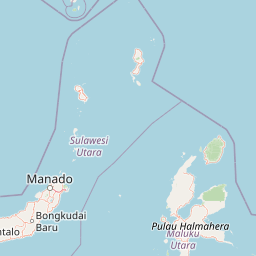
Nearest Populated Places
ShakeMap — predicted shaking intensity
Modeled ground-motion intensity contoured on the Modified Mercalli scale (MMI). Computed by the USGS from the moment-tensor solution and regional ground-motion prediction equations.
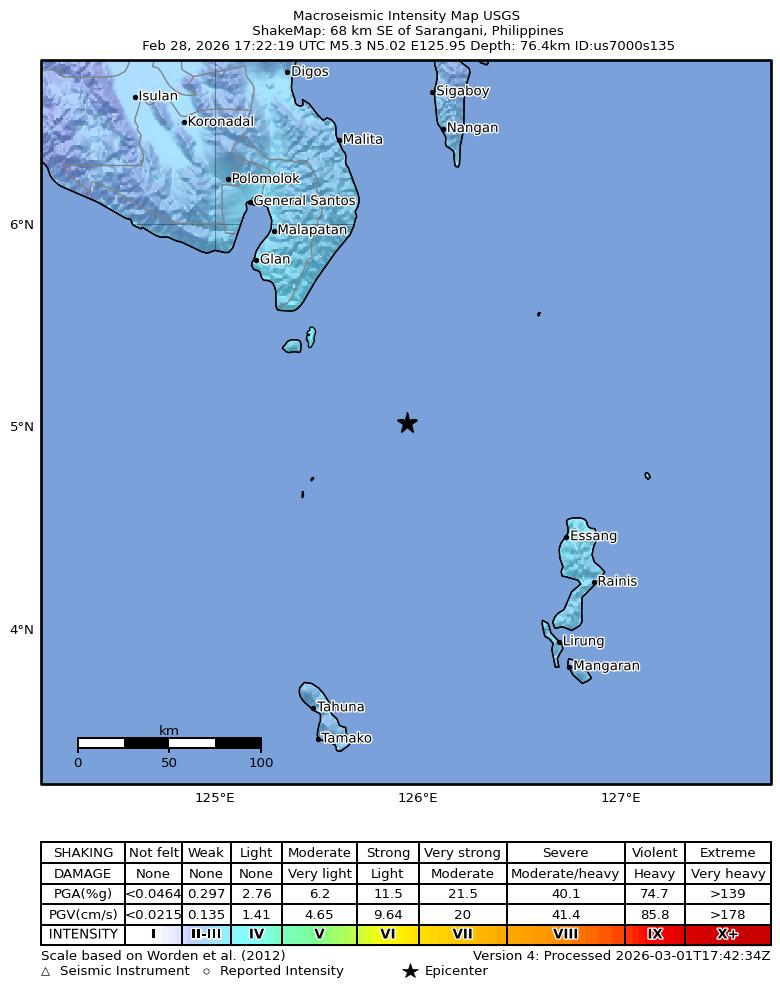
Source: U.S. Geological Survey ShakeMap. View interactive ShakeMap on USGS
Did You Feel It? — community-reported shaking
Aggregated felt-report intensity from 2 citizen responses to the USGS Did You Feel It? system. Each colored zone represents the average MMI from reports in that area.
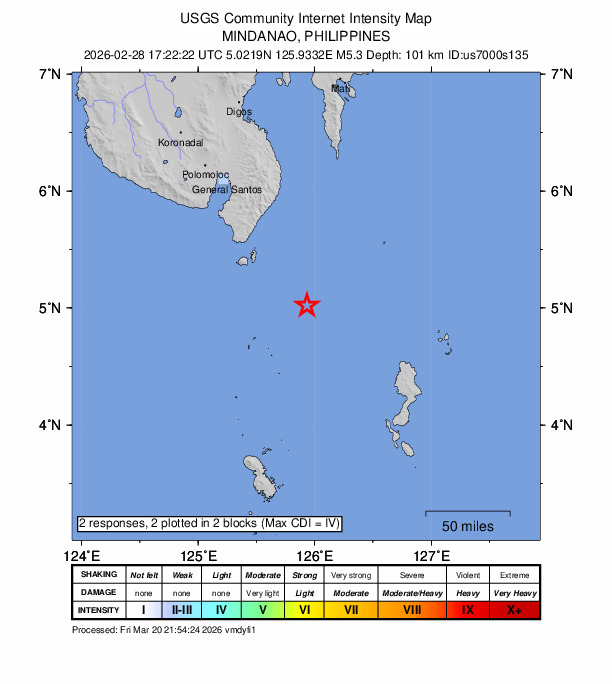
Source: U.S. Geological Survey Did You Feel It?. View on USGS · submit your own report
Population exposure (USGS PAGER)
Estimated population that experienced each level of shaking. Based on the USGS PAGER rapid impact assessment, which combines ShakeMap output with global population grids.
| Shaking intensity (MMI) | Description | Population exposed |
|---|---|---|
| MMI 3 | weak | 4,369,098 |
| MMI 4 | light | 5,251 |
Earthquake Details
125.9332°E
Technical Information
Nearby Earthquakes (Last 7 Days)
Common Questions
How strong was the magnitude 5.3 earthquake near Sarangani, Philippines?
The magnitude 5.3 earthquake that struck 67 km SE of Sarangani, Philippines on February 28, 2026 at 17:22 UTC had a depth of 101.3 km. It was felt by 2 people with maximum shaking intensity of MMI 3.9 (light). For context, this was a moderate earthquake that could be widely felt.
Where did the earthquake occur?
The earthquake epicenter was located at 5.0219°, 125.9332°, which is 67 km SE of Sarangani, Philippines. The nearest populated place is Sarangani (population 7,506). View all earthquakes in Philippines.
Were there aftershocks?
Aftershock activity is monitored continuously by the USGS. Aftershock sequences from magnitude 5.3 earthquakes can continue for days to weeks and gradually diminish over time.
Has Philippines had earthquakes this big before?
The largest recorded earthquake in Philippines was the M8.0 Mindanao earthquake of August 17, 1976. Today's magnitude 5.3 event is significantly smaller than that historical record.
Authoritative source: USGS event page (event ID: us7000s135). All scientific values on this page are sourced verbatim from the USGS feed.
Cite this page: EarthquakeTracker.org. (2026, February 28, 2026). M5.3 Earthquake 67 km SE of Sarangani, Philippines — February 28, 2026. Retrieved May 15, 2026 from https://www.earthquaketracker.org/earthquakes/event/us7000s135/