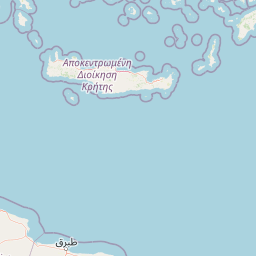
M5.1 Earthquake 24 km S of Sitia, Greece — April 24, 2026
2026-04-24 08:58:17 UTC (2026-04-24) · approx. 10:58 AM UTC+2 local
Felt by 1 person across nearby locations.
On April 24, 2026 at 08:58 UTC, a magnitude 5.1 shallow crustal earthquake struck 24 km S of Sitia, Greece, at a depth of 10.0 km and coordinates 34.9878°, 26.1103°. This earthquake was detected by 64 seismic stations with excellent location accuracy and was assigned a USGS significance rating of 401, placing it among routine seismic activity.
Physical scale: An earthquake of magnitude 5.1 releases seismic energy equivalent to roughly 674 metric tons of TNT. Empirical fault-scaling laws (Wells & Coppersmith, 1994) estimate the subsurface rupture length at approximately 2.0 km — a useful intuition for the size of the slip patch on the fault.
The epicenter is located in Greece, a region characterized by the Hellenic subduction zone, where the African Plate subducts northward beneath the Aegean at roughly 35 mm per year. The nearest mapped fault system is the Hellenic Trench. View all earthquakes in Greece.
Learn more: Magnitude scale · Aftershock sequences
Did You Feel It? — community-reported shaking
Aggregated felt-report intensity from 1 citizen response to the USGS Did You Feel It? system. Each colored zone represents the average MMI from reports in that area.
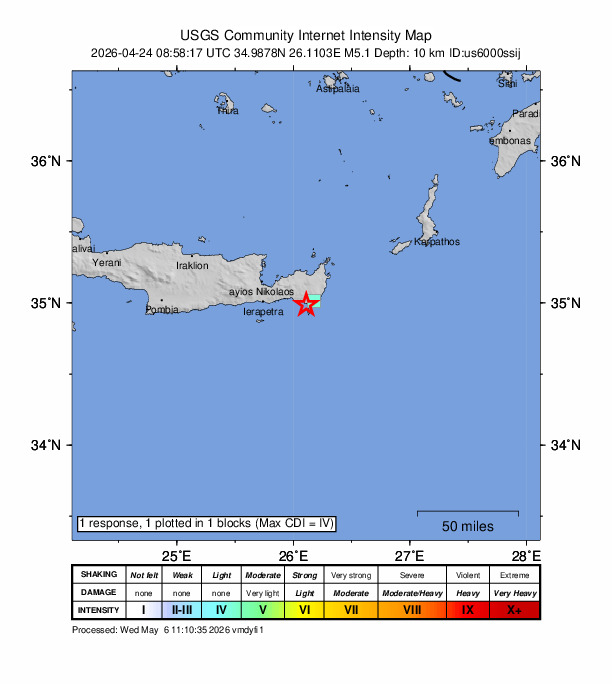
Source: U.S. Geological Survey Did You Feel It?. View on USGS · submit your own report
Earthquake Details
26.1103°E
Technical Information
Common Questions
How strong was the magnitude 5.1 earthquake near Sitia, Greece?
The magnitude 5.1 earthquake that struck 24 km S of Sitia, Greece on April 24, 2026 at 08:58 UTC had a depth of 10.0 km. For context, this was a moderate earthquake that could be widely felt.
Where did the earthquake occur?
The earthquake epicenter was located at 34.9878°, 26.1103°, which is 24 km S of Sitia, Greece. View all earthquakes in Greece.
Were there aftershocks?
Aftershock activity is monitored continuously by the USGS. Aftershock sequences from magnitude 5.1 earthquakes can continue for days to weeks and gradually diminish over time.
Has Greece had earthquakes this big before?
The largest recorded earthquake in Greece was the M8.5 Crete earthquake of June 29, 1303. Today's magnitude 5.1 event is significantly smaller than that historical record.
Authoritative source: USGS event page (event ID: us6000ssij). All scientific values on this page are sourced verbatim from the USGS feed.
Cite this page: EarthquakeTracker.org. (2026, April 24, 2026). M5.1 Earthquake 24 km S of Sitia, Greece — April 24, 2026. Retrieved July 11, 2026 from https://www.earthquaketracker.org/earthquakes/event/us6000ssij/